
A Storied Career began curating and documenting the world of applied storytelling in May 2005, had its most active period between 2008 and 2010, and had its most recent post (before this one) in 2014. Read the full history. While I am undecided about ever posting in this blog again, I believe it is a worthy artifact of the world of applied storytelling during the period of active publication. The blog has MANY broken links, but a plug-in at least shows which links are broken, possibly reducing reader frustration. I hope to eventually fix many of these broken links, as well as re-publish my series of 100 Q+A interviews with story practitioners. Please contact me if you have questions or comments about the blog.
Job-Search Storytelling Continues to Evolve: New Nuances
by Katharine Hansen, Ph.D.
When I began my doctoral dissertation on the subject of storytelling in the job search nearly 10 years ago, the concept was largely unheard of. Today, the storied approach is so deeply ingrained in the world of career communication that 18 career gurus had no trouble producing rich articles on aspects of career storytelling for Job Action Day 2014. This mainstreaming of stories in job search means that job-seekers can find a vast array of resources online and off about how to effectively integrate story into job-search communication. In this article, we’ve curated some of the best.
- When it comes to telling stories in job interviews, probably the most popular story structure advised by career experts is STAR: Situation, Task, Action, Result. But, writing on the Careers – in Theory blog, David Winter suggests a different story structure, BARER.
- Background – Winter suggests only the minimum the listener needs to know to understand your actions
- Actions – what you did and how you did it
- Reasons – why you did those things rather than something else
- Explained result – what the outcome was and why it was the result of your actions
- Reflection and re-application – what you learned from the experience and how it’s been useful
Why this formula? “If you want to impress an experienced interviewer, just talking about your Actions and the Result will not be enough,” Winter asserts. “If you just describe what you did, I don’t know whether your actions have arisen from conscious decision making or as an automatic response to external conditions. I don’t know whether the result came about because of your actions or just the prevailing circumstances.” Winter’s isn’t the only formula that includes reflection and learning, but it’s certainly an approach worth considering.
- Another popular interview-story formula is SOAR, in which O for Obstacles takes the place of T for Task in the STAR structure. Career expert Thea Kelley touts the importance of the obstacles portion of the story for demonstrating the ability to overcome challenges. Without the obstacles piece, she writes here, the accomplishment might seem too easy, and communication of the skills involved in the achievement would not be as dramatic.

- A story formula known as The Pixar Pitch has made the rounds in recent years. Initially set forth by Emily Coats, the Pitch was featured in Daniel Pink’s book To Sell is Human. Here’s how it goes:
Once upon a time _____. Every day_____. One day_____. Because of that_____. Because of that_____. Until finally_____.
Conduct a Google search on The Pixar Pitch, and you’ll find several examples, but it’s harder to find an example applied to an individual and suitable for job-seeking. A sample published by Tom Cooper of the BrightHill Group perhaps comes the closest and can serve as a model for job-seekers:
- Once upon a time, many years ago I was young geek who worked on software and IT projects.
- Every day I watched too many good people and good projects fail to meet business goals. Have you ever seen failed projects at work? It hurts, doesn’t it?
- One day I discovered the secret to successful projects. I learned that leadership is the key to effectively moving people and delivering business value.
- Because of this I began to study what it means to be a leader and how to lead others effectively. I learned that leadership is a skill that can be learned,
and over time I practiced those skills and became a better leader. - Because of this new awareness, I began to see that few tech leaders understood this secret. Few of them ever study these types of skills. I really wanted to help them learn what I learned.
- Until finally I created a business with to help tech leaders get more from their teams. Would you like to know how I do it?
- Of course, an interview story structure can be quite simple, such as the one recommended by Diane Windingland on her blog:
Then -> Now -> How. You describe what the situation was then, what it is now (after you have taken action to improve the situation), and how you accomplished the Now. “By delaying ‘how’ until after the ‘now,'” Windingland says, “you get people leaning forward and wanting to hear the how.”
- Are you an auditory learner? As a supplement to Walter Akana’s Job Action Day 2014 article, Five Keys to Developing Your Personal Brand Story, listen to Akana interviewed by Jeff Rock on Blog Talk Radio. In the 38-minute interview, titled Developing Your Brand Story with Walter Akana, the interviewee asserts that much of today’s personal-branding advice is image-building rather than the communication of who you really are. Akana followed up this interview with a blog post about framing your story as a quest. “Find your quest and your story will take care of itself,” he says.
- Stories can help an employer visualize you in a role, says Thomas Crouser, Jr, in Tell a Great Story, Get a New Job! “If the interviewer(s) visualize YOU in the role, the probability that you will become their next employee (or advance to the next step of the process) increases significantly!,” Crouser writes. He cites storytelling guru Doug Stevenson, who notes, “If you want to make a positive impression at the same time you’re making a point, you’ve got to use stories.”
- A pithy story that encapsulates one’s career is a must, and it goes by several names — elevator pitch, elevator story, career narrative, or response to the ubiquitous interview request to “tell me about yourself.” Heidi K. Gardner and Adam Zalisk believe that younger workers especially need this kind of story, particularly within the workplace so senior executives can grasp their appropriateness for assignments
to projects and promotions. A powerful example, they say, of such a career narrative might be:“I worked in labs through college and entered the firm with a strong interest in health-care clients. I’ve had the opportunity to develop my quantitative financial skills in the comfortable context of health care. Now I’d like to test those skills with other commercial clients to determine what industry most interests me over the long term.”
The authors note, of course, that the story must be dynamic and change as your situation and accomplishments change.
- Another use/incarnation of a concise, overarching story of who you are is the About Me page on your blog or Web site or the
100-word bio. A fantastic resource for learning to construct one of these stories is How to Make Your Story Shine, a lengthy,
10-step tutorial that takes the user through a process for creating an effective story. The basics include:- Present who you are (answering the ever-important facts, up front)
- Show where you’ve been (including your credentials, background, context, etc.)
- Explain where you intend to go in your work/in your life (ie, this is what you’re driving at, and why you’re doing anything at all)
- Invite the reader to join you, get on board, work with you, etc. (in other words, how to continue the relationship you’ve sparked)
- The concept of storied resumes has caught fire in recent years, and many resume writers claim to tell their clients’ stories in these documents.
One company, Storyresumes, focuses exclusively on graphically driven resumes that are story-based. While these graphic resumes cannot be read by employers’ Applicant Tracking software, they can be useful for networking, taking to an interviewer, or publishing on a personal Website of social-media venue. See a post about this company and what inspired its founder Andrea Martins to start it.
Final Thoughts on Career Storytelling Resources
These resources are just the tip of the iceberg of a vast variety of career-storytelling resources that have emerged in recent years. For much more on the subject, visit our Career Storytelling section.

This article is part of Job Action Day 2014.
Telling Your Career Story: 4 New Approaches
by Hannah Morgan
Standing out in a job search has never been more challenging. Companies receive hundreds of applications for a single job. Some recruiters will look at your resume for only six seconds, according to a study by TheLadders. To capture the attention of potential employers, you need to be innovative and try new methods to garner attention.
Historically, the resume was the only tool available to tell your career story. Today, you have many more options to draw attention to your career achievements, if you are willing to step outside your comfort zone and try something new. You will still need a traditional text-based resume, but you can captivate your audience by supplementing your story by using these four new formats to tell your story.
Storytelling has been around forever. It was the earliest form of “edutainment,” the combination of educational and entertaining content. Good storytellers captivated an audience by using stories, which created mental images and formed an emotional connection. This combination resulted in memorable, sharable stories passed down through generations. Think about stories delivered by Steve Jobs, any TED Talk, or a Walt Disney  movie. They all contain stories that have similar recipe for success. Garr Reynolds, founder of PresentationZen.com, one of the most popular Websites on presentation design and delivery, believes three basic elements contribute to every great story:
- A problem is identified.
- The causes of the problem are spelled out.
- A resolution is envisioned and implemented.
1. Tell the Story of Your Career Through a Presentation
Your career has been dynamic. A resume is just words on a page and limits your ability to convey the true essence of your career. Why not use a dynamic format to show off what you’ve done? You will need to start by building a strong story. Think of it as your pitch. Create the storyline for your presentation as if you were answering the question, “why should I hire you?” And keep in mind the three-part formula; what is the problem you solve, what causes the problem, and how have you successfully resolved this problem in the past. The magic of storytelling happens when you incorporate powerful images and words to create a memorable story. Now you are ready to select the tool you will use to convey your message.
Tool choices include PowerPoint, Prezi, Keynote, Haiku Deck, Google Presentations.
2. Deploy a Portfolio To Illustrate Your Story
Artists, designers and models have used portfolios forever to show their work. Portfolios provide tangible proof they have experience. You can have an online portfolio, too. Show your samples of work, photos from events you attended, awards you’ve won, even customer testimonials. Embed these documents and pictures in the Summary or Experience sections of your LinkedIn profile to enhance your message and provide evidence you can do the job. And if you are serious about managing your online visibility, why not create a simple Website that hosts your samples of work and resume and serves as a portfolio. Complicated coding skills or a large budget are no longer required to create a personal website.
Tool choices include: Behance, Carbonmade, eOlio, LinkedIn, SquareSpace, Weebly, WordPress.
[Editor’s Note: See also this section of Quintessential Careers: Career Portfolio Tools and Resources for Job-Seekers.]
3. Convert Text Into Visuals
As the saying goes, a picture is worth a thousand words. Infographics simplify complex ideas by using images. Convert your career story into an infographic resume as a supplement. Your LinkedIn profile can easily be converted into an infographic or you can create an infographic from scratch. But don’t stop there. You want to draw attention to your infographic. Add it to your portfolio, LinkedIn profile, and even within your presentation. Your infographic could be just the thing to capture the attention of 65 percent of the population who are visual learners, according to the Social Science Research Network. See this recent post for more about infographic resumes.
Tool choices include: Beyond, Kelly and Visual.ly’s infographic resume, Kinzaa, PictoCV, ResumUp, Re.vu, Vizualize.me.
4. Tell Your Story through Social-Media Activity
Some career professionals and recruiters say that online search results for your name and social-media streams are the new resume. You are being googled, so why not highlight your activity in one spot for anyone to easily find. A social resume is another alternative for telling your story. Collect and show off your blog posts, tweets, Instagram photos, and other status updates to provide a real-time demonstration of your communication and social media savvy.
Tool choices include: About.me, Career Cloud’s Social Resume, Flavors.me, Pixelhub, Strickingly.
Final Thoughts: Don’t Hide Your Story Away In a Folder
Instead of relying on resume-posting sites and hoping an employer will find you irresistible, take ownership of promoting your talent
by sharing your story through multiple media formats! You’ve accomplished great things, and it is up to you to make sure that your
successes are visible outside your current company and are known to people beyond your manager.
Begin sharing your memorable story today.
Hannah Morgan is a speaker and author on job-search and social-media strategies. She delivers fresh advice to and serves as a guide to the treacherous terrain of today’s workplace landscape. Hannah’s experience in human resources, outplacement services, workforce development and career services equip her with a 360-degree perspective on job-search topics. Recognized by media and career professionals, Hannah is an advocate who encourages job-seekers to take control of their job search. Hannah is frequently quoted in local and national publications such as Money magazine, and she writes a weekly column for U.S. News & World Report. Hannah is the author of The Infographic Resume (McGraw Hill Education, 2014) and co-author of Social Networking for Business Success (Learning Express, 2013). You can learn more about Hannah on CareerSherpa.net and by following her on Twitter at
@careersherpa.
For Job-Search Success, Banish the Negative Story in Your Head
Note: This article appeared as part of Job Action Day 2014 and is reprinted here.
by Susan Britton Whitcomb
We all have an ongoing story that runs on autopilot through our minds. It’s the silent chatter – often negative – that self-criticizes, anticipates what will go wrong, second-guesses, assumes what other people are thinking, interprets or misinterprets events, and more. It might go some something like this:
I’m never going to get a job. Employers just aren’t hiring. If I’d only kept up my exercise routine – it’s going to be harder to get a job with these extra pounds around my middle. What a slug I am… I got let go because I make too much. It’s going to be hard to compete against the younger kids who are willing to make a lot less than I’ve been making… That human-resources guy never called me back. Probably never will. I know I blew it in the telephone screen. Stupid, stupid, stupid – I can’t believe I didn’t remember to talk about my accomplishments when he asked me that surprise question. I hate looking for a job. It sucks.
Neuroscientists have a name for this silent chatter. It’s called the Default Network (also known as the Narrative Network). Unless we are very  intentional about our thinking, we do, indeed, default to the Default Network. We spend 60-70 percent of our time in this zone, and, in doing so, allow ANTs (Automatic Negative Thoughts) to subtly sabotage our success.
Why should job-seekers pay attention to the inside story? Because left unchecked, negative thoughts can distract and derail us. They send us into a self-induced fight-flight response that shuts down our creativity and hijacks our critical thinking skills. We get off-agenda, off-course, off-kilter, and off of our best self.
It’s difficult to convince networking contacts, interviewers, and colleagues of our value if we don’t believe it ourselves.
These Tips can help you manage Your Inside Story
Notice the narrative without judging yourself. It’s important that we not deride ourselves further for the narrative thoughts, because that only exacerbates the situation. Just notice the thoughts, such as, “I hear those ANTs again. Interesting. I hadn’t realized what I was thinking.”
Transcend the Narrative Network. Get into a different network – the Experiential Network – a state where we are very aware of ourselves and our surroundings, taking in information through our five senses. For example, “I notice that I’m hungry; I can hear the fan of my computer kicking on; the sky is an interesting shade of blue right now.”
Choose gratitude. Gratitude can change the chemistry inside our bodies, releasing serotonin, dopamine, and other neurochemicals that make us feel good. Speak your gratitude aloud, even if just to yourself. Extend gratitude not just for the people in your life, but to yourself, as well. For example, I am grateful for the strengths I have that are helping me manage this transition.
Construct a new happy-ending story. Rehearse it. Positive visualizations create new neural wiring in our brains, which makes it easier for us to repeat the same success in the future. For example, “I can see myself meeting with my networking contact this afternoon. I walk in with shoulders back, head held high, smile on my face. I am using my strengths as a researcher to connect with him and understand his background and his needs. I listen and respond in ways that create trust so he’s more comfortable referring me to others.”
Final Thoughts
Writing a strong “inside story” allows us to confidently deliver the messages we need to convey to friends, colleagues, and hiring managers throughout a career transition. Here’s to a happy ending!
Susan Britton Whitcomb, PCC, is the author of seven careers books, including Resume Magic, Interview Magic, and Job Search Magic. A Certified Brain-Based Success Coach, she brings practical application to neuroscience research to help people create careers that are meaningful and financially rewarding. Founder and President of TheAcademies.com, her coach training organization has trained more than 1,000 coaches worldwide in career, leadership, and job search coaching.
Founder of StoryResumes Touts: Marketing Savvy + Story = Get Noticed Faster in Your Job Search
Storytelling continues to emerge as a mainstream technique in job-search communication, a technique we celebrate and explore during this year’s Job Action Day.
To get noticed in your job hunt, you don’t have to create and mail out 400 action figures of yourself as Jens Lennartsson did, create imitation medicine boxes as pharmaceutical copywriter Jon Ryder did, or lose a fake passport at ad agencies like design student Miruna Macri did – although admittedly, those creative resume tactics are ingenious.
You do have to stop, reassess what you’ve achieved in your career and what you’d now most like to achieve, and then weave your value into a compelling story that is custom-made for your dream role/company.
Thus, you need to invest time in articulating your value, instead of rush typing your resume in your lunch break. It also means that you need to invest time in researching your dream role/company and then presenting yourself (usually via your cover letter and resume) in an impactful and memorable way that matches that specific role/company.
To create impact, more and more marketing-savvy candidates are turning to creative resumes that help grab a recruiter’s attention faster. Creative resumes can be problematic if they cannot be read by the Applicant Tracking Software that most employers use to harness the constant inundation of resumes. Creative resumes, however, can be worth considering to complement (not replace) your traditional resume.
 One new company that can help you with a creative resume is Story Resumes. The company creates customized, eye-catching resumes via infographics, illustrations, and animated videos (which cannot be read by employer software). Founder Andrea Martins reached out to me when her service launched earlier this year.
Andrea created Story Resumes after her frustrating experience as a job-seeker. When she was not being noticed in her job hunt, she used her initiative and turned her resume into a story, then commissioned illustrations to match. Soon after, Andrea was receiving phone calls from recruiters, interviews and job offers.
This success in itself demonstrates both the power of story, and what candidates can achieve if they are proactive in their job search. But perhaps what I love most about the service is that it practices exactly what I have advocated for so many years:
Marketing Savvy + Story = Get Noticed Faster in Your Job Search.
Whether you demonstrate marketing savvy via an infographic resume, an action figure or just a brilliantly articulated cover letter and resume, this formula is one of the best-hidden weapons in your job search arsenal. Use it.
Storytelling: Underused in Online Teaching
Using stories and storytelling in online teaching is an underused method of increasing student engagement and interest. Here are just five of many takeaways from recent writings about story in teaching:
Present and encourage narrative in case studies. Case studies are inherently stories. In his book, How to Do Your Case Study, author Gary Thomas emphasizes the narrative aspects of case studies, especially in the sciences. “Assume that whatever you want to study,” Thomas writes, “has, not causes, but a history, a story, a narrative, a ‘first this happened, then that happened, and then the other happened, and it ended up like this.’ With this view we understand the occurrence of events by learning the steps in the process by which they came to happen, rather than by learning the conditions that made their existence necessary.”
Introduce new material in story form. Presenting material in story form improves comprehension and memory. Again looking at the sciences, Arya and Maul tested the presentation of content in “typical expository fashion or in terms of a personal story of the scientist,” relates Daniel Willingham in The Washington Post. The advantage of story over expository was significant.
Engage student learning by evoking anticipation through stories. Ray Jimenez, a significant guru of story-based eLearning design, whom I cite in my chapter of Modern Instructor: Success Strategies for the Online Professor, espouses the idea that “Story-based eLearning design is effective because it creates an environment where learners are compelled to anticipate. The vagueness of ‘what’s next’ keeps the mind engrossed until the story finds a resolution. Very few people can resist the power of a good story.”
Let students construct endings to unconcluded stories. Consider learning activities in which students speculate on a story with no ending – or one with an enigmatic ending. Jimenez cites the famed blackout ending to the “Sopranos” TV series, in which any number of outcomes have been speculated. “After hooking the learners with a well-written and engaging story, the open-ended ending allow[ed] the viewers [to] decide how to end their story,” Jimenez notes. Instructors can apply that approach to online learning: “As the learners attempt to put an ending to an unconcluded story,” he says, “different insights contribute to the development of the lesson.” In his post about unconcluded stories, Jimenez offers guidelines on how to create a story-based elearning lesson with an impactful open ending.
Use short bursts of learning, counter-intuitive story principles, and social-media tools. That’s the advice of organizational consultant, trainer, and author Terrence Gargiulo, who offers an information-packed how-to on LinkedIn. Gargiulo refers to “conversationally driven web-based live online learning programs” containing what he calls the ‘Triple Threat of Storytelling:’ telling stories, listening to stories and triggering stories.” The capacity for learning to trigger stories in participants, he says is key.
The permutations of possibility for using story are nearly endless. You can learn more in Modern Instructor: Success Strategies for the Online Professor.
A Story of the Story-Gathering Informational-Interview Technique
I’m republishing this post in conjunction with publication today of my second in a series of short books on highly focused career and job-search topics. The book is Quick and Quintessential Guide: The Best-Kept Networking Secret; it’s just 99 cents till Jan. 18.
I am a huge believer in the not-well-known practice of informational interviewing. While informational interviewing has a setup similar to a job interview, getting a job is not its purpose, at least not directly. As David Rothacker explains in a blog post about his daughter’s experience with informational interviewing, a person driving the info-interview process might be “in search of knowledge specific to marketing in her town, its players of influence and career advice.”
Essentially, informational interviewing, invented by hallowed career guru/author Richard Bolles of What Color Is Your Parachute fame, is research into jobs, careers, and employers. But it’s also a subset of networking because the process enables the job-seeker to make new contacts and ask for referrals, as Rothacker’s daughter Victoria did:
When the conversation was over, Victoria asked, “Can you please refer me to someone who would be willing to have a similar conversation with me?” Mr. Jones recommended the CEO of a medium-sized companay and made an introductory call for Victoria the next day.
Rothacker describes the professional package of leave-behinds Victoria gave to her interviewees and the fact that she always wrote them thank-you notes. Significantly, she made a informational interviewing into a very deliberate and concerted program that was the centerpiece of her job-search efforts for a period:
This process continued for six months with Victoria meeting on average, one person per week. Due to the referrals, she stayed consistently at the CEO, owner and marketing director levels. As conducting informational interviews was a primary focus throughout this period, she scored several appointments with individuals outside of this direct line of referrals as well.
Here’s where good planning comes in. Job-seekers who are in a position to mount a slow, deliberate approach — such a college students approaching graduation or prospective career-changers already employed — can gain much ground through informational interviewing without the pressure of a frantic job search and actual job interviews. The process also provides invaluable practice in interview and interpersonal-communication skills that will boost the job-seeker down the line. Rothacker explains that Victoria got a job outside the circle of the informational interviews she conducted, but that the sessions had still been invaluable to her search:
Victoria’s adventure taught her how to talk with owners and executives. It taught her how to interview and how to be interviewed. It taught her how to talk about herself and it sharpened her listening and communication skills. It also provided a broad, invaluable glimpse into the real world of business – one that most young people do not have the advantage of before starting their career. Finally, and in Victoria’s case, it provided one very powerful caveat: many of the people who Victoria interviewed with, turned out to people in authority of companies whom she needed to conduct business with in her new position.
Rothacker titles the blog post “The Story Seeker,” and indeed, one of the most valuable aspects of informational interviewing is that it enables the job-seeker not only to collect the stories of her interviewees but to share her own. Through this story exchange, an emotional connection is established, and both interviewer and interviewee become memorable to each other. Victoria maintained contact with her informational-interviewees long after she got a job.
I became an evangelist for informational interviewing after my students experienced remarkable results with them. One semester I gathered metrics that showed 21 percent of my roughly 100 students had received job or internship offers through informational interviewing. Not a high number, but impressive when you consider that getting offers isn’t even the purpose of the process
Based on that experience, I wanted to write a book about informational interviewing. My publisher found the topic too narrow, so I ended up writing a book about networking (A Foot in the Door), with about a third of it dedicated to the story-gathering process that is informational interviewing. I cannot recommend informational interviewing highly enough. Those who’d like to try it can check out my tutorial, one of the links I most often share with job-seekers.
For his part, Rothacker has created a Facebook page, Standing out in a Sea of Sameness, which he describes this way:
Standing out in a Sea of Sameness is where students come to learn about storytelling, to learn how to solve problems, make new stuff and make stuff better and more pleasing by developing a mindset and following a process. It’s about how to stand out from their peers.
Business Parable Teaches Networking: Bonuses Come with Oct. 1 Release
This blog has frequently reflected my long-time fascination with business books told as fables, stories, or parables.
A new one to be published Oct. 1 is at the core of what A Storied Career is about: storytelling and job search and career. (Disclaimer: I haven’t read it.)
Authors Sukenick and Williams present a range of real-world situations, insights, and challenges through the eyes of a fictional character with whom, they assert, “almost anyone can relate.” Gnik Rowten (that’s “networking” spelled backward) has made a fresh start in a new city where he has few if any friends, prospects, or business contacts.
The book traces Gnik’s life over a 3-week period, as each day he discovers and learns tools, techniques, and strategies for effective business networking. Through sharing his successes, failures, and “Aha!” moments, readers learn to extend, deepen, and effectively utilize their personal and business networks.
“It’s a common misconception that you need to be naturally outgoing and tech-savvy to master the art of networking,” Sukenick says. “What many people and organizations don’t recognize is that networking, like any other skill, can be learned through study and practice.”
The experiences depicted in 21 Days to Success Through Networking are realistic, the authors claim, and its lessons are easy to customize and apply. A companion website allows readers to “connect” with the book’s fictional protagonist Gnik Rowten, who can also be followed on Twitter.
Author Bonus Offer to Amazon Buyers for One Day Only—Tuesday, Oct. 1, 2013
Sukenick announced that he will offer an array of online and offline tools at no cost to anyone who purchases 21 Days to Success Through Networking on Amazon on Oct. 1. Details here. Or email Sukenick. See a 9-minute interview with the authors.
SlideShare Holding “Startup Story” Contest
I’ve written a number of times in this space about SlideShare’s story-oriented slide-presentation contests, the winners of which, I opined, were not always successful in telling stories with slides.

The site’s September Upload Contest has an interesting premise: My Startup Story. “Every person, product, team and company started somewhere — tell us that story,” the site requests. Interesting that SlideShare includes “person” as the possible center of a startup story.
More from the site about the contest:
What were your beginnings and how did you get to where you are now? What were the challenges, turning points, aha moments and lessons learned? Upload your startup story by Sept. 30, 2013, and be sure to tag it MyStartupStory for the chance to win a free SlideShare PRO account and be reviewed by Silicon Valley gurus Guy Kawasaki, Dave McClure, Hunter Walk and Douglas Crets!
Even if you have no interest in entering, you can see startup-story slideshows here, where you can also learn more about the contest.
New Dimensions in Story-Based Job Search
I’m always on the lookout for ways to apply storytelling to job search and career. Here are a few I’ve encountered recently:
An article on the (Bill) Moyers & Company site by, I believe, Marshall 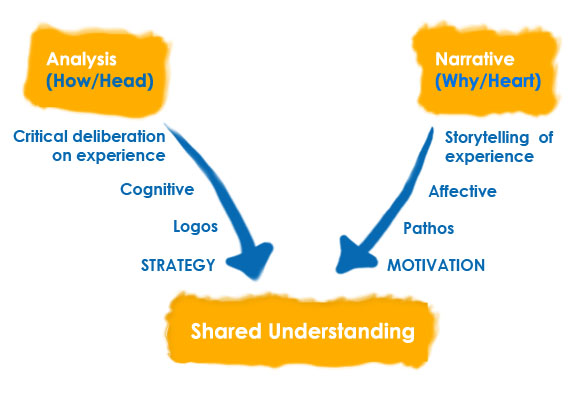 Ganz, is aimed at how organizers of social movements can tell their stories. But the article offers great advice to job-seekers, too. The author states, “A story of self tells why we have been called to serve. It expresses the values or experiences that call each person to take leadership on a given issue.” (The graphic shows how “the key to storytelling is understanding that values inspire action through emotion. We experience our values emotionally — they are what actually move us to act. Because stories allow us to express our values not as abstract principles, but as lived experience, they have the power to move others to action as well.”)
The same can be said about why we do our jobs and progress in our careers. The author goes on to talk about “choice points: moments in our lives when values are formed because of a need to choose in the face of great uncertainty.”
The author’s story structure focused on choice points is analogous the the many variations on story structures for job-seekers that go something like: Situation –> Action –> Result.
In this case, the formula is Challenge —> Choice —> Outcome.
For the most part the questions the author recommends around this structure are completely appropriate for constructing stories a job-seeker can use in an interview or even a resume or cover letter:
Challenge: What was the specific challenge you faced? Why did you feel it was a challenge? What was so challenging about it? Why was it your challenge?
Choice: What was the specific choice you made? Why did you make the choice you did? Where did you get the courage (or not)? Where did you get the hope (or not)? How did it feel?
Outcome: What happened as a result of your choice? What hope can it give us? How did the outcome feel? Why did it feel that way? What did it teach you? What do you want to teach us? How do you want us to feel?
I’ve long advised job-seekers that they don’t have to collect a massive number of stories to respond to interview questions because a single story can be manipulated in response to a multitude of questions. Ten stories is a good number to shoot for, but you can get by with seven, five, or even three (see my Three Success Stories exercise handout), as Rebecca Thorman affirmed in a recent article:
Instead of trying to prepare 50 answers for 50 different possible interview questions, go through your résumé and cover letter and pick three key work experiences that you’re proud of and that illustrate your relevant skills, experience and lessons learned. … By exploring a few stories from your past, you don’t have to worry about memorizing all the right answers to a myriad of potential questions.
 A case study is essentially a story. Branding expert Dan Schawbel advises using case studies to advance one’s career – in other words, stories of your experience and accomplishments. But what if you don’t have much experience, or it’s in the wrong field?
“When you have no experience or are looking to make a career change,” Schawbel writes, “using yourself as a case study is one strategy that can bail you out and help you form a foundation to build on.” If you don’t have the experience or the right experience, he says, “do what you would be doing for a company for yourself first.”
Schawbel, for example, designed Web sites for his own interests while in college and then used case studies of those creations to obtain clients.
To advance your career, sometimes, you need to not only tell your story in the form of a case study but create the story to tell.